Quantcast
Channel: temperature | Battery Guide
Viewing all 365 articles
Browse latest View live

$3.6 GPRS GSM MODULE FROM AI THINKER

$
0
0

ShenZhen Ai-thinker CO.,a leading enterprise in the Internet of Things (IoT) industry and the maker of the ESP-12E module, had launched a new killer module: $3.60 GSM GPRS A6 Module!

Providing a chip cheaper than the popular ESP8266 seems to be promising and opens doors for future IoT inventions. This module seems to be a big competitor for SIM900 series module.

This chip is considered the cheapest platform that connects to the internet via GSM/GPRS and at the same time works as a traditional GSM module.

$3.6 GPRS GSM MODULE FROM AI THINKER

This module is coming in market as a SMT package, like ESP12E, but there are many vendors already making breakout board with antenna out and SIM card slot, for an extra dollar.

Technical Specifications
  • Dimensions 22.8 × 16.8 × 2.5mm;
  • Working temperature -30 Celsius to + 80 Celsius;
  • Working voltage 3.3V-4.2V;
  • Power voltage> 3.4V;
  • Standby average current 3ma less;
  • Support GSM / GPRS four bands, including 850,900,1800,1900MHZ;
  • Support China Mobile and China Unicom’s 2G GSM network worldwide;
  • GPRS Class 10;
  • Sensitivity <-105;
  • SMT 42PIN
  • Support voice calls;
  • Support SMS text messaging; can use SMS to config module
  • Support GPRS data traffic, the maximum data rate, download 85.6Kbps, upload 42.8Kbps;
  • Supports standard GSM07.07,07.05 AT commands and extended commands;
  • Supports two serial ports, one serial port to download an AT command port;
  • AT command supports the standard AT and TCP / IP command interface;
  • Support digital audio and analog audio support HR, FR, EFR, AMR speech coding;
  • Support ROHS, FCC, CE, CTA certification;
  • Support up to 8 channels network connections
  • Low power consumption: standby least is 3mA
  • A6 semi-hole technology, enabling rapid production modules through standard SMT equipment, providing customers with highly reliable connection, especially for automation, large-scale, low-cost modernization of production methods.
$3.6 GPRS GSM MODULE FROM AI THINKER

It can be used with AT Commands like the commands for other GPRS/GSM modules SIM800/SIM900. Thus, it is possible to use the same libraries

How To Use A6 GSM GPRS Module:
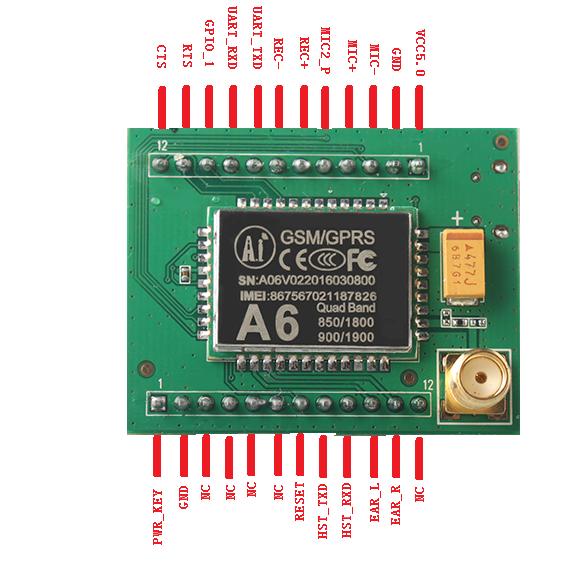
  1. Connect UART_TXD to RX of the FTDI
  2. Connect UART_RXD to TX of the FTDI
  3. Connect GND to the GND of the FTDI
  4. Connect VCC5.0 To the PWR_KEY pin
  5. Connect a Micro Usb for the power(with any smartphone charger)
  6. After 4-5 second you can remove the connection between VCC5.0 and PWR_Key

You can use it with the Arduino software, just choose a port and open the serial monitor with 115200 baud. To set up the connection send ”AT”, and if you see “OK” then everything works.

A project using the module, download the software, documents, and codes from here. Also watch a test demo.

The module is said to be the smallest available industrial grade quad-band GSM / GPRS module. You can order A6 module for $3.20 from ElectroDragon store.

Datasheet is only available in Chinese. More details about the A6 – A6c – A7 family can be reached at this document and at the A6 module documentation.


Source: $3.6 GPRS GSM MODULE FROM AI THINKER

The post $3.6 GPRS GSM MODULE FROM AI THINKER appeared first on PIC Microcontroller.


MAX16126/MAX16127 – PROTECT POWER-SUPPLY INPUTS FROM AUTOMOTIVE VOLTAGE TRANSIENTS

$
0
0

MAX16126/MAX16127 – protect power-supply inputs from automotive voltage transients, including load dump

MAX16126 MAX16127 – PROTECT POWER-SUPPLY INPUTS FROM AUTOMOTIVE VOLTAGE TRANSIENTS

The MAX16126/MAX16127 load-dump/reverse-voltage protection circuits protect power supplies from damaging input voltage conditions, including overvoltagereverse-voltage, and high-voltage transient pulses. Using a built-in charge pump, the devices control two external back-to-back n-channel MOSFETs that turn off and isolate downstream power supplies during damaging input conditions, such as an automotive load-dump pulse or a reverse-battery condition. Operation is guaranteed down to 3V to ensure proper operation during automotive cold-crank conditions. These devices feature a flag output (active-low FLAG) that asserts during fault conditions.

For reverse-voltage protection, external back-to-back MOSFETs outperform the traditional reverse-battery diode, minimizing the voltage drop and power dissipation during normal operation.

The MAX16126/MAX16127 use external resistors to adjust the overvoltage and undervoltage comparator thresholds for maximum flexibility.

The MAX16127 provides limiter-mode fault management for overvoltage and thermal shutdown conditions; whereas the MAX16126 provides switch-mode fault management for overvoltage and thermal shutdown conditions. In the limiter mode, the output voltage is limited and active-low FLAG is asserted low during a fault. In the switch mode, the external MOSFETs are switched off and active-low FLAG is asserted low after a fault. The switch mode is available in four options: latch mode, 1 autoretry mode, 3 autoretry mode, and always autoretry mode.

The MAX16126/MAX16127 are available in 12-pin TQFN packages. These devices operate over the automotive temperature range (-40°C to +125°C).

Key Features

  • Increases Protection of Sensitive Electronic Components in Harsh Environments
    • -36V to +90V Wide Input-Voltage Protection Range
    • Fast Gate Shutoff During Fault Conditions with Complete Load Isolation
    • Thermal-Shutdown Protection
    • Active-Low FLAG Output Identifies Fault Condition
  • AEC-Q100 Automotive Qualified
    • Operates Down to +3V, Riding Out Cold-Crank Conditions
    • -40°C to +125°C Operating Temperature Range
  • Integration Reduces Solution Size
    • Internal Charge-Pump Circuit Enhances External n-Channel MOSFETs
    • Adjustable Undervoltage/Overvoltage Thresholds
    • 3mm x 3mm, 12-Pin TQFN Package
  • Reduced Power Dissipation Compared to Discrete Solutions
    • Minimal Operating Voltage Drop for Reverse- Voltage Protection
    • 350µA (max) Supply Current and 100µA (max) Shutdown Current at 30V Input

Read more: MAX16126/MAX16127 – PROTECT POWER-SUPPLY INPUTS FROM AUTOMOTIVE VOLTAGE TRANSIENTS

The post MAX16126/MAX16127 – PROTECT POWER-SUPPLY INPUTS FROM AUTOMOTIVE VOLTAGE TRANSIENTS appeared first on PIC Microcontroller.
Temperature-to-period circuit provides linearization of thermistor response

$
0
0

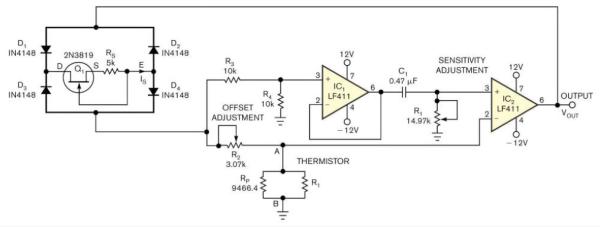
Designers often use thermistors rather than other temperature sensors because thermistors offer high sensitivity, compactness, low cost, and small time constants. But most thermistors’ resistance-versus-temperature characteristics are highly nonlinear and need correction for applications that require a linear response. Using a thermistor as a sensor, the simple circuit in Figure 1 provides a time period varying linearly with temperature with a nonlinearity error of less than 0.1K over a range as high as 30K. You can use a frequency counter to convert the period into a digital output. An approximation derived from Bosson’s Law for thermistor resistance, RT, as a function of temperature, θ, comprises RT=AB–θ (see sidebar “Exploring Bosson’s Law and its equation”). This relationship closely represents an actual thermistor’s behavior over a narrow temperature range.

Temperature-to-period circuit provides linearization of thermistor response

Figure 1

This simple circuit linearizes a thermistor’s response and produces an output period that’s proportional to temperature.

You can connect a parallel resistance, RP, of appropriate value across the thermistor and obtain an effective resistance that tracks fairly close to AB–θ 30K. In Figure 1, the network connected between terminals A and B provides an effective resistance of RAB AB–θ. JFET Q1 and resistance RS form a current regulator that supplies a constant current sink, IS, between terminals D and E.

Through buffer-amplifier IC1, the voltage across R4 excites the RC circuit comprising R1 and C1 in series, producing an exponentially decaying voltage across R1 when R2 is greater than RAB. At the instant when the decaying voltage across R1 falls below the voltage across thermistor RT, the output of comparator IC2changes its state. The circuit oscillates, producing the voltage waveforms in Figure 2 at IC2‘s output. The period of oscillation, T, is T=2R1C1ln(R2/RAB)2R1C1[ln(R2/A)+θlnB]. This equation indicates that T varies linearly with thermistor temperature θ.

Read more: Temperature-to-period circuit provides linearization of thermistor response

The post Temperature-to-period circuit provides linearization of thermistor response appeared first on PIC Microcontroller.

ARBOR’S “EMQ-RK390” QSEVEN MODULE RUNS LINUX OR ANDROID ON A ROCKCHIP RK3399

$
0
0

ARBOR Technology, a leading provider of embedded computing solutions, which featured this year on concluded Embedded World 2019 Exhibition that took place in Nuremberg, Germany has launched the EmQ-RK390 Qseven module which is based on the RK3399-based SoC. The Qseven concept is an off-the-shelf, multi-vendor, Computer-On-Module that integrates all the core components of a standard PC and is mounted onto an application specific carrier board.

ARBOR’S “EMQ-RK390” QSEVEN MODULE RUNS LINUX OR ANDROID ON A ROCKCHIP RK3399

The EmQ-RK390 Qseven module was announced during the event and even displayed at their booth. The launch of the EmQ-Rk390 will be a new direction from Arbor due to the presence of the RK3399 SoC as compared to the previous Intel Apollo Lake-based modules. The RK3399 SoC has dominated the single board computers market for a while with several boards released.

Arbor’s EmQ-RK390 Qseven module runs Linux-UbuntuBuiltroot and Android 8.1 on an onboard Rockchip RK3399 Dual-core Cortex-A72 clocked up to 2.0GHz. It also comes with an additional Quad-core Cortex-A53 processor running up to 1.42GHz. The board comes with an inbuilt 2GB LPDDR3 SDRAM and support for an optional 4GB with soldered 16GB eMMC memory. Just like most other RK3399 based boards, this board also features a high-end, quad-core Mali-T864 GPU.

The board dimensions is in line with Qseven standardized form factor of 70mm x 70mm. At -20 to 70°C temperature, the EmQ-RK390 module is tailored to work in the most demanding industrial environment. Although it doesn’t come with an onboard wireless card, it comes with a USB-based RTL8153B GbE controller and a PCIe x4 interface for connecting to the internet or some other network system.

Read more: ARBOR’S “EMQ-RK390” QSEVEN MODULE RUNS LINUX OR ANDROID ON A ROCKCHIP RK3399

The post ARBOR’S “EMQ-RK390” QSEVEN MODULE RUNS LINUX OR ANDROID ON A ROCKCHIP RK3399 appeared first on PIC Microcontroller.

Sensirion Announces Its New Liquid Flow Sensor – SLF3S-1300F

$
0
0

The SLF3S-1300F liquid flow sensor is based on Sensirion’s proven CMOSens® Technology and optimizes costs by simplifying the design without sacrificing the easy fluidic, electrical and mechanical connections. The straight and unobstructed flow channel has no moving parts; inert wetted materials provide outstanding chemical resistance and excellent media compatibility. In measuring flow rates up to 40 ml/min bi-directionally, the sensor allows monitoring the entire system operation and detecting common failure modes.

Sensirion Announces Its New Liquid Flow Sensor – SLF3S-1300F

The SLF3S-1300F enables applications in the fields of diagnostics, analytical instruments and life sciences to reach unparalleled fluid control, system reliability and thus new heights in performance and end-user satisfaction. Its compact form factor and cost-effective design permit system designs with one or more sensors that were previously unfeasible.

Samples of the SLF3S-1300F liquid flow sensor are available now for testing. Please contact Sensirion for further information at info@sensirion.com.

Features:

  • Highly integrated: Linearized, temperature-compensated and fully calibrated digital output signal (I2C) from a single chip
  • Full scale flow rate for water-based liquids: 40 ml /min
  • Turn down ratio 200:1 or better
  • High speed measurement: Response time below 20 ms
  • Bidirectional measurement and real time failure detection
  • Easy fluidic and electrical integration via ¼″-28 flat bottom ports and a standard connector
  • Straight, unobstructed flow channel without moving parts
  • Media isolated sensing principle: no direct sensor contact with the fluid
  • Compact and light-weight form factor
  • Chemically resistant wetted materials

Commercial release of the sensor is planned for 2019.

Discover the SLF3S-1300F liquid flow sensors at this year’s Electronica (Hall B3, Booth 417) and COMPAMED (Hall 8a, Booth H19.6) trade fairs.

Read more: Sensirion Announces Its New Liquid Flow Sensor – SLF3S-1300F

The post Sensirion Announces Its New Liquid Flow Sensor – SLF3S-1300F appeared first on PIC Microcontroller.

BATTERY FUEL GAUGE EVALUATION KIT FOR WEARABLES AND PORTABLE DEVICES

$
0
0

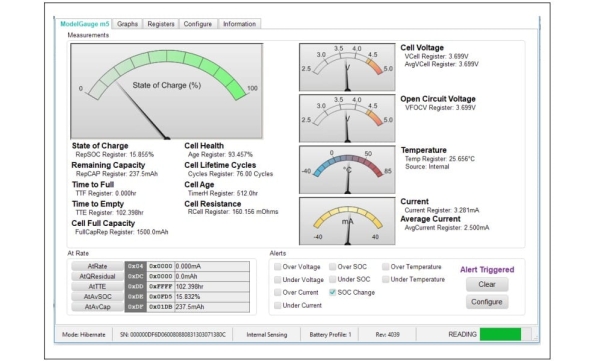
The MAX17262X evaluation kit (EV kit) from Maxim Integrated Products is a fully assembled and tested surface-mount PCB that evaluates the stand-alone ModelGauge™ m5 host-side fuel-gauge IC for lithium-ion (Li+) batteries in handheld and portable equipment.

BATTERY FUEL GAUGE EVALUATION KIT FOR WEARABLES AND PORTABLE DEVICES

This EV kit supports a variety of applications such as: Bluetooth Headset Cases, Handheld Computers and Terminals, Health and Fitness Monitors, Home and Building Automation, Sensors, Medical Devices, Toys, Wearables and Smartwatches, and similar devices.

The MAX17262X EV kit includes the Maxim DS91230+ USB interface, IC evaluation board, and RJ-11 connection cable. Windows®-based graphical user interface (GUI) software is available for use with the EV kit and can be downloaded from Maxim’s website. Windows 7 or newer Windows operating system is required to use with the EV kit GUI software.

The ModelGauge m5 EZ makes fuel-gauge implementation easy by eliminating battery characterization requirements and simplifying host software interaction. The ModelGauge m5 EZ robust algorithm provides tolerance against battery diversity for most lithium batteries and applications.

Features And Benefits

  • ModelGauge m5 Algorithm
  • Monitors from 1S Cell Packs
  • Battery Pack Input Voltage Range of +2.3V to +4.9V
  • Thermistor Measurement Network
  • Windows 7 or Newer Compatible Software
  • Proven PCB Layout
  • Fully Assembled and Tested

The ModelGauge m5 EZ algorithm combines the short-term accuracy and linearity of a coulomb counter with the long-term stability of a voltage-based fuel gauge, along with temperature compensation to provide industry-leading fuel-gauge accuracy. The IC automatically compensates for cell-aging, temperature, and discharge rate, and provides accurate state-of-charge (SOC) in percentage (%) and remaining capacity in milliampere-hours (mAh) over a wide range of operating conditions.

Read more: BATTERY FUEL GAUGE EVALUATION KIT FOR WEARABLES AND PORTABLE DEVICES

The post BATTERY FUEL GAUGE EVALUATION KIT FOR WEARABLES AND PORTABLE DEVICES appeared first on PIC Microcontroller.

COMPULAB AIRTOP3 IS BRINGING PERFORMANCE TO THE EDGE

$
0
0

Compulab is introducing Airtop3 – a ruggedized small-form-factor fanless IoT edge server powered by an 8-core Intel® Core™ i9-9900K Processor and Nvidia Quadro RTX 4000, both passively cooled using Compulab’s Natural Airflow technology. With a footprint of just 7.5 liters, Airtop3 can passively dissipate up to 300W and operate at a wide temperature range of -40°C to 70°C. Airtop3 ships with a 5 year warranty.

COMPULAB AIRTOP3 IS BRINGING PERFORMANCE TO THE EDGE

Fanless Core I9 9900K And Quadro RTX 4000

IoT edge server can reduce processing latency, network bandwidth requirements and TCO, provided that it is sufficiently powerful, robust and easy to deploy.

Airtop3 presents a unique value proposition for edge computing in harsh environments:

  • Exceptionally high performance – 8-core, up to 5 GHz Intel Core™ i9-9900K or Intel Xeon coupled with Nvidia Quadro RTX or GeForce GTX GPU and high RAM capacity up to 128 GB
  • Rich storage, networking and I/O, each can be enhanced thanks to Airtop3’s modular design
  • Passive cooling across wide temperature range and a rugged all-aluminium small-form-factor housing
  • Maintenance-free design, tool-free serviceability and advanced monitoring and diagnostics provisions

Apparently, the appetite for performance at the IoT edge knows no boundaries”

said Irad Stavi, Chief product officer at Compulab.

“We are seeing remarkable performance gains in the latest generation of CPUs and GPUs, but with great power comes greater power consumption. However, our engineers were able to improve the thermal headroom of Airtop3’s Natural Airflow cooling by over 30% so there was no need to settle for low power chips. This makes Airtop3 a small-form-factor fanless IoT edge server with unprecedented performance.”

“Benchmarks indicate that Airtop3 is nearly twice as powerful as Airtop2”

said Yuval Sela, Airtop hardware architect.

“To achieve that, power delivery in Airtop3 is completely revamped and can now support the most powerful Intel 9th generation Core CPUs and even 160W NVIDIA RTX GPU.

Read more: COMPULAB AIRTOP3 IS BRINGING PERFORMANCE TO THE EDGE

The post COMPULAB AIRTOP3 IS BRINGING PERFORMANCE TO THE EDGE appeared first on PIC Microcontroller.

GW16130 MINI-PCIE SATELLITE MODEM FOR IOT APPLICATIONS

$
0
0

The GW16130 is a Mini-PCIe Satellite Modem Radio adapter that provides cost-effective, short burst satellite connectivity for asset tracking, fleet management, telemetry, oceanographic data, grid monitoring and Internet of Things (IoT) applications.

GW16130 MINI-PCIE SATELLITE MODEM FOR IOT APPLICATIONS

The GW16130 features an Iridium 9603N satellite transceiver which allows two-way communications anywhere in the world with a clear line of sight to the sky. The Iridium network consists of 66 satellites and provides 24/7 world wide coverage. The 9603N module is used for short burst data packets (340bytes uplink, 270bytes downlink) and perfect for IoT remote sensor applications with minimal non-realtime data requirements. The GW16130 adapter will work in a full size Mini-PCIe socket that includes a USB 2.0 interface. See the Gateworks website for suggested single board computers that can be used with this adapter. Serial communications to the module is through an onboard FTDI USB to UART bridge. All power conditioning circuitry is contained on the board in addition to an u.Fl antenna connector for connecting an external satellite antenna. Note that an Iridium approved satellite antenna must be used when operating on the Iridium network. The GW16130 adapter requires a monthly data plan which can be established with a number of 3rd party providers. Typical data charges are ~$20 USD per month with 12Kbytes of data included. See the Gateworks Support Wiki for more information on recommended antennas and data plans.

Features

  • Iridium 9603N SBD Satellite Transceiver
  • Small lightweight module for embedded applications
  • Offers low cost, low bandwidth satellite communications
  • Max Message payload: 340 bytes upload, 270 bytes download
  • Automatic message notification on incomming messages
  • Operates anywhere on earth including North & South Poles
  • Supports E-mail messages or HTTP POST
  • Simple UART AT command interface
  • Operating frequency: 1616MHz to 1626.5MHz
  • 1.6W Average transmit power
  • -117dBm Receiver sensitivity
  • Full industrial temperature operation
  • No SIM card required
  • Onboard u.Fl antenna port for antenna connection
  • Full size Mini-PCIe mechanical form factor

Read more: GW16130 MINI-PCIE SATELLITE MODEM FOR IOT APPLICATIONS

The post GW16130 MINI-PCIE SATELLITE MODEM FOR IOT APPLICATIONS appeared first on PIC Microcontroller.


MULTI-GAS, HUMIDITY AND TEMPERATURE MODULE FOR AIR PURIFIERS AND HVAC APPLICATIONS

$
0
0

The solution for gas, humidity and temperature sensing remotely from the main control board is now available worldwide through Sensirion’s distribution network.

MULTI-GAS, HUMIDITY AND TEMPERATURE MODULE FOR AIR PURIFIERS AND HVAC APPLICATIONS

Sensirion, the expert in environmental sensing, now offers a multi-gas, humidity and temperature module, the SVM30. The module facilitates product development and sensor integration while at the same time offering great flexibility for product design. The SVM30 is especially suitable for customers that prioritize lean development and products, and perfectly appropriate for small and medium-sized companies. Based on Sensirion’s experience and expertise in environmental sensing, the SVM30 is optimized for easy design-in and sensing performance. The SVM30 is a multi-gas, humidity and temperature sensor combo module containing an SGP30 gas sensor as well as an SHTC1 humidity and temperature sensor.

The SGP30 gas sensor combines multiple metal-oxide sensing elements – the pixels – on one chip, thereby offering the possibility of measuring a total VOC signal (tVOC) and a CO2 equivalent signal (CO2eq) with one single sensor chip. The SVM30 also offers calibrated air quality output signals as well as compensation of humidity cross-sensitivity. The gas sensing element features unmatched robustness against contamination by siloxanes present in real-world applications, enabling unique long-term stability and low drift. Furthermore, the integrated SHTC1 humidity and temperature sensor covers a humidity measurement range of 0 to 100% relative humidity (RH) and a temperature measurement range of -20 to 85°C with a typical accuracy of ±5% RH and ±1°C. The gas, humidity and temperature sensor components are designed with Sensirion’s proven CMOSens® Technology. This technology offers a complete sensor system on a single chip, including the sensing elements, analog and digital signal processing, A/D converter, calibration and data memory as well as a digital communication interface supporting the I2C standard mode. Sensirion’s state-of-the-art production process, including full calibration and testing of the sensors, guarantees high reproducibility and reliability.

Read more: MULTI-GAS, HUMIDITY AND TEMPERATURE MODULE FOR AIR PURIFIERS AND HVAC APPLICATIONS

The post MULTI-GAS, HUMIDITY AND TEMPERATURE MODULE FOR AIR PURIFIERS AND HVAC APPLICATIONS appeared first on PIC Microcontroller.

CISSOID TO EXHIBIT NEW HIGH TEMPERATURE GATE DRIVERS, SIC MOSFET’S AND POWER MODULES

$
0
0

CISSOID, the leader in high temperature semiconductors for the most demanding markets, will present new High Temperature Gate DriversSiC MOSFET’s and IGBT Power Modules at PCIM 2019, the world’s leading exhibition and conference for power electronics, intelligent motion, renewable energy, and energy management.

CISSOID TO EXHIBIT NEW HIGH TEMPERATURE GATE DRIVERS, SIC MOSFET’S AND POWER MODULES

The company is introducing a new Gate Driver board optimized for 62mm Silicon Carbide (SiC) MOSFET Power Modules rated at 125°C (Ta). This board, based on CISSOID HADES gate driver chipset, can also drive IGBT Power Modules whilst offering thermal headroom for the design of high density power converters in automotive and industrial applications. It enables high frequency (>100KHz) and fast SiC MOSFET’s switching (dV/dt>50KV/µs), improving efficiency and reducing size and weight of the power converters. The board is designed for harsh voltage environments supporting the drive of 1200V and 1700V power modules with isolation voltages up to 3600V (50Hz, 1min) and creepage distances of 14mm. Protection functions such as undervoltage lockout (UVLO), Active Miller Clamping (AMC) and Desaturation detection ensure the safe drive and reliable protection of the power module in case of fault events. “This new SiC Gate Driver board is the outcome of several years of developpement working with industry leaders in Automotive, Transportation and Aerospace markets. It combines CISSOID expertise in SiC Devices with our long experience in designing chips and electronic systems for harsh environments” says Etienne Vanzieleghem, CISSOID VP of Engineering.

In Nuremberg, CISSOID will also present new SiC MOSFET’s and IGBT Power Modules. A new discrete 1200V/40mOhms SiC MOSFET transistor is available in a TO-247 package and fully characterized from -55°C up to 175°C. This MOSFET features a drain-to-source On Resistance of 40mOhms at 25°C (Tj) and 75mOhms at 175°C (Tj). Low switching turn-on and turn-off energies, respectively 1mJ and 0.4mJ, are making this device ideal for efficient and compact DC-DC converters, power inverters and battery chargers. The company will also present two 62mm 1200VIGBT Power Modules with 200A and 300A current rating.

Read more: CISSOID TO EXHIBIT NEW HIGH TEMPERATURE GATE DRIVERS, SIC MOSFET’S AND POWER MODULES

The post CISSOID TO EXHIBIT NEW HIGH TEMPERATURE GATE DRIVERS, SIC MOSFET’S AND POWER MODULES appeared first on PIC Microcontroller.

BREAKTHROUGH IN CO2 SENSING: FIRST SENSIRION MINIATURIZED CO2 SENSOR

$
0
0

Once again, Sensirion trailblazes innovation in environmental sensing to create healthier and more productive environments for people. At this year’s Sensor+Test 2019 in Nuremberg and SensorsExpo 2019 in San José, the expert in environmental sensing, Sensirion, is announcing the SCD40 – the first miniaturized CO2and RH/T sensor that fits in a space of just one cubic centimeter. This disruptive innovation is based on the photoacoustic sensing principle and combines minimal size with maximum performance to open up numerous new integration and application possibilities. Due to its unprecedented price-performance ratio, the SCD40 is especially well suited for high-volume and cost-sensitive applications.

BREAKTHROUGH IN CO2 SENSING FIRST SENSIRION MINIATURIZED CO2 SENSOR

Sensirion’s profound expertise in miniaturizing sensors has enabled a breakthrough step in CO2 sensing: with dimensions of just 12 x 12 x 7 mm3, the SCD40 footprint has been miniaturized by a factor of 5 compared to its predecessor, the SCD30. Using the photoacoustic sensing principle, the dimensions of the optical cavity are drastically reduced without compromising on sensor performance. Moreover, the SCD40 CO2 and RH/T sensor leverages Sensirion’s outstanding environmental sensing expertise by incorporating a best-in-class humidity and temperature sensor that delivers two additional sensor outputs. Because of its unmatched size and its unprecedented price-performance ratio, the SCD40 is the sensor of choice for today’s and future CO2 sensing markets such as IoT, automotive, HVAC, appliances and consumer goods.

Visit Sensirion at the Sensor+Test 2019 at booth no. 316 in hall 1 as well as at the SensorsExpo 2019 at booth no. 324 in hall M2 to experience the new sensor solution live in action. Furthermore, there will be an exclusive meeting with a live demonstration for selected customers at both events, offering a deeper insight into the upcoming innovation and its availability.

Read more: BREAKTHROUGH IN CO2 SENSING: FIRST SENSIRION MINIATURIZED CO2 SENSOR

The post BREAKTHROUGH IN CO2 SENSING: FIRST SENSIRION MINIATURIZED CO2 SENSOR appeared first on PIC Microcontroller.

SYSTEM-ON-MODULE WITH POLARFIRE FPGA AT EMBEDDED WORLD

$
0
0

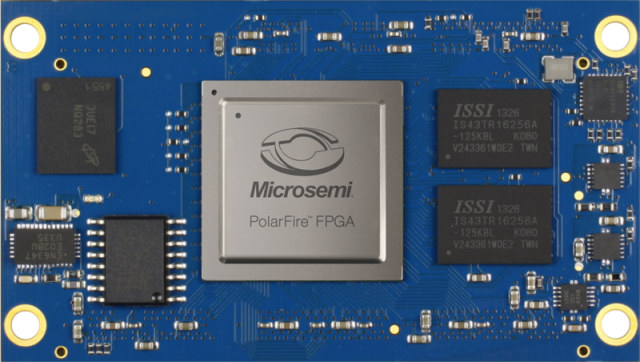
Specialist for embedded services and products, ARIES Embedded, will display the new M100PF System-on-Module (SoM) based on Microchip’s PolarFire FPGA family at embedded world 2019. At stand 441 in hall 3A ARIES Embedded will also introduce the complementary evaluation platform M100PFEVP, which delivers a fast and easy project start for customers.

SYSTEM-ON-MODULE WITH POLARFIRE FPGA AT EMBEDDED WORLD

Our new M100PF board provides the full flexibility of the popular FPGAs for demanding applications in industrial and medical technology,

stated Andreas Widder, Managing Director of ARIES Embedded.

PolarFire captivates with up to 50 percent lower power consumption than competing FPGAs, at mid-range densities with exceptional safety and reliability.

With the SoM, ARIES Embedded extends the FPGA functionality with RAM, Flash, Clocking and additional features.

For industrial use, the system-on-module allows an expanded temperature range, from zero to +70°C up to -40 to +85°C. On the ARIES SoM, the PolarFire FPGAs provide 100, 192, or 300k logic elements (LE) and feature 12.7G transceivers with up to 50% lower power consumption. The 256 Mbit configuration storage, the DDR3 RAM (512Mbit, one or two gigabit), as well as four to 64Gbit eMMC NAND Flash allow the development of complex high performance designs.

Further features of the 72x40mm small SoMs are: eight SerDes with 250Mbps to 12.5Gbps, two PCI express Gen2 end points/root port slots, rich user I/O, and two Samtec QSH-090-01-F-D-A board-to-board connectors.

ARIES Embedded provides the corresponding evaluation platform M100PFEVP to help facilitate a smooth and fast project start. It enables customers to evaluate the PolarFire FPGA, realise prototypes and even use the FPGA in series production. The evaluation board contains two gigabit Ethernet, USB, and four DSub9 interfaces for CAN, RS232, and others, in addition to Pmod and HSMC extension connectors and a microSD card slot.

Read more: SYSTEM-ON-MODULE WITH POLARFIRE FPGA AT EMBEDDED WORLD

The post SYSTEM-ON-MODULE WITH POLARFIRE FPGA AT EMBEDDED WORLD appeared first on PIC Microcontroller.

AVNET INTEGRATED ADDS AMD’S R1000 TO ITS COM EXPRESS

$
0
0

Avnet Integrated has incorporated AMD’s R1000 embedded processor family, based on the Ryzen core architecture, into its COM Express Type 6 modules. The ready-to-use computer on modules (COMs) enable developers to quickly implement the new processor technology in compact embedded systems for a rapid introduction of innovative end products, claims Avnet. The desired performance data can be easily scaled via the processor platform.

AVNET INTEGRATED ADDS AMD’S R1000 TO ITS COM EXPRESS

The R1000-based module platform in COM Express Compact form factor features high graphics performance that can replace an external solution in price-sensitive applications. Another advantage is the low power dissipation of 12 to 25W. In addition to the R1000 accelerated processing unit (APU) with dual-core, the modules integrate a dual channel DDR4 memory with optional error-correcting code (ECC).

There are common embedded interfaces such as PCI Express and connections for up to three independent 4K displays. Some module variants are designed for the industrial temperature range from -40 to +85 degrees C. The boards, which were developed for the embedded market, are available for at least 10 years from the product launch of the processor, assures Avnet.

Typical areas of use for the R1000-based COM Express module family are applications with high graphics requirements and large data volumes, for example, in medical technology, human machine interface (HMI) systems, gaming and entertainment products.

The R1000 embedded processor family has the same architecture as the AMD V1000 processors. Both processor families are socket-compatible and can be scaled, both in terms of performance and cost, according to the specific application. In addition to the R1000, Avnet Integrated also offers V1000-based product variants to provide customers with the whole range of performance spectrum.

Read more: AVNET INTEGRATED ADDS AMD’S R1000 TO ITS COM EXPRESS

The post AVNET INTEGRATED ADDS AMD’S R1000 TO ITS COM EXPRESS appeared first on PIC Microcontroller.

ULTRA-SMALL BAROMETRIC PRESSURE SENSOR DPS368 FROM INFINEON IS PROTECTED AGAINST WATER DUST & HUMIDITY

$
0
0

Infineon Technologies AG launches the XENSIV TM DPS368. The miniaturized digital barometric pressure sensor is capable of measuring both pressure and temperature. It offers an ultra-high precision of ±2 cm and a low current consumption for precise measurement of altitude, air flow and body movements. This makes the DPS368 ideal for mobile applications and wearable devices offering e.g. activity tracking and navigation. Additionally the sensor can be used in home appliances for airflow control, in drones for flight stability and in medical devices such as smart inhalers.

ULTRA-SMALL BAROMETRIC PRESSURE SENSOR DPS368 FROM INFINEON IS PROTECTED AGAINST WATER DUST & HUMIDITY

Due to its robust package, it can withstand 50 m under water for one hour (IPx8) and protects the sensing cells against dust and humidity. As a result, the board handling in an assembly line is also facilitated. The 8-pin LGA package with its small dimensions of 2.0 x 2.5 x 1.1 mm³ saves up to 80 percent space compared to other waterproof sensors.

The pressure sensor element is based on a capacitive sensing principle that guarantees high precision even during temperature changes. The internal signal processor converts the output from the pressure and temperature sensor elements to 24-bit results. Calibration coefficients stored in the sensor are used in the application to convert the measurement results to high accuracy pressure and temperature values. DPS368 provides quick feedback due to a measurement rate of up to 200 Hz and fast read-out speed. The integrated FIFO memory can save up to 32 measurement results, allowing for power-savings on system level.

The XENSIV DPS368 sensor features an average low power consumption of 1.7 μA for pressure measurements at 1 Hz sampling rate. In standby mode, this is reduced to 0.5 μA. The sensor operates at pressure ranges from 300 to 1200 hPa and temperature ranges from -40 to +85 °C with a temperature accuracy of ±0.5 °C. Sensor measurements and calibration coefficients are available through the serial I²C or SPI interface.

Read more: ULTRA-SMALL BAROMETRIC PRESSURE SENSOR DPS368 FROM INFINEON IS PROTECTED AGAINST WATER DUST & HUMIDITY

The post ULTRA-SMALL BAROMETRIC PRESSURE SENSOR DPS368 FROM INFINEON IS PROTECTED AGAINST WATER DUST & HUMIDITY appeared first on PIC Microcontroller.

LITTELFUSE SETP™ TEMPERATURE INDICATOR HELPS PROTECT USB TYPE-C PLUGS FROM OVERHEATING

$
0
0

Littelfuse expands its PolySwitch setP series of digital temperature indicators, introducing the SETP0805-100-CC which is designed to protect USB Type‑C and USB power delivery charging cables from overheating. It is optimised for use in cables equipped with USB Type-C connectors at both ends.

LITTELFUSE SETP™ TEMPERATURE INDICATOR HELPS PROTECT USB TYPE-C PLUGS FROM OVERHEATING

Typical applications for SETP0805-100-CC temperature indicators include consumer electronics, primarily for mobile and wearable devices equipped with USB Type-C cables (with a Type-C plug on each end) and USB Type-C chargers (such as cables fixed or captive to a charger for laptops).

When dust, dirt, or other debris is trapped in a USB Type-C cable connector or the connector has deformed pins, it creates a resistive fault from the power line to ground, which can cause a dangerous temperature rise without increasing the current. When the temperature reaches the setP’s indicating temperature (100 degrees C), the setP switches from low resistance to very high resistance, shutting down the flow of power. Once the user disconnects the cable and removes the debris, the cable can resume normal operation.

The compact 0805 footprint of Littelfuse’s setP temperature indicators makes them at least 50 per cent smaller than other versions that require placing a device on the power line, claims Littelfuse. The setP devices can be used to protect cables designed for 100 W of power or more.

The number of consumer electronics, wireless, and computing devices equipped with USB Type-C connectors sold each year is estimated to reach 5bn by 2021. This is expected to spur demand for products that can protect cables and connectors from overheating damage. The SETP0805-100-CC temperature indicators are claimed to offer the smallest, most energy-efficient solution available today to protect people and electronics against overheating.

Read more: LITTELFUSE SETP™ TEMPERATURE INDICATOR HELPS PROTECT USB TYPE-C PLUGS FROM OVERHEATING

The post LITTELFUSE SETP™ TEMPERATURE INDICATOR HELPS PROTECT USB TYPE-C PLUGS FROM OVERHEATING appeared first on PIC Microcontroller.


MINI-ITX FORM FACTOR BOARD HAS FOUR VIDEO OUTPUTS WITH UP TO 6-CORE PERFORMANCE

$
0
0

WADE-8211-Q370 Scalable Processing Power Gives Design Flexibility and Is Ideal for Industrial Automation, Medical Equipment and IoT Applications.

MINI-ITX FORM FACTOR BOARD HAS FOUR VIDEO OUTPUTS WITH UP TO 6-CORE PERFORMANCE

Portwell , a world-world-leading innovator in the Industrial PC (IPC) market and an Associate member of the Intel Intelligent Systems Alliance program, today announces the release of the WADE-8211-Q370, a new Mini-ITX form factor embedded system board based on the 8th Generation Intel Core™ processor (formerly Coffee Lake) and Intel Q370 Express chipset. Along with four independent video outputs, the WADE-8211 also utilizes the 8th Generation Intel Core Processor, built on 14nm process technology utilizing 3D Tri-gate transistor technology, resulting in increased performance and improved energy efficiency. The Mini-ITX Board includes Intel Turbo Boost Technology for faster processing, Intel vPro™ Technology for superior remote configuration capabilities and Intel Hyper-threading for multithreaded processing. These features translate into reduced manageability cost and improved security, making the WADE-8211 an ideal solution for Industrial Automation, Medical Equipment, Transportation and Retail Systems.

Based on Mini-ITX form factor, the WADE-8211 is right-sized perfectly for applications with small footprint computer and supports the powerful Intel Core™ i7 / i5 / i3 (8th gen.) and the Intel Pentium® / Intel Celeron® processor series. It is equipped with the highly performant Intel Q370 Express Chipset and guarantees highest functionality on a small-sized surface with Intel AMT 12.0 and vPro support, 2x Intel GbE LAN and BIOS configurable PCI Express Lane. It is designed and tested for enhanced operating temperature range up to 60°C and 24/7 continuous operation.

The WADE-8211-Q370 supports up to 32GB Non-ECC DDR4 memory up to 2133MHz on two 260-pin SO-DIMM sockets making it faster than its predecessor. Its expansion interface supports one PCI Express x16 Gen3 (8.0GT/s) for enhanced video performance and support one Mini-PCIe and two M.2 slots (one M.2 Type E socket (2230) for Wireless, one M.2 Type M socket (2242/2260/2280) for SSD).

Read more: MINI-ITX FORM FACTOR BOARD HAS FOUR VIDEO OUTPUTS WITH UP TO 6-CORE PERFORMANCE

The post MINI-ITX FORM FACTOR BOARD HAS FOUR VIDEO OUTPUTS WITH UP TO 6-CORE PERFORMANCE appeared first on PIC Microcontroller.

TEMPERATURE FAN CONTROL LCD SCREEN TCN75 SENSOR PIC16F84A PICBASIC

$
0
0

The control circuit DS1621 application with which we have previously circuit ( PIC16F84A temperature fan control with LCD display -55 ° C / +125 ° C Picbasic ) TCN75 carried out with heat sensor… Electronics Projects, Temperature Fan Control LCD Screen TCN75 Sensor PIC16f84A PICBASIC “microchip projects, microcontroller projects, pic16f84 projects, picbasic pro examples, “

TEMPERATURE FAN CONTROL

The control circuit DS1621 application with which we have previously circuit ( PIC16F84A temperature fan control with LCD display -55 ° C / +125 ° C Picbasic ) TCN75 carried out with heat sensor state.

And we use this circuit to TCN75 DS1621 temperature sensor is a PIN to PIN . For this reason, we use the previous circuit , I use the same printed circuit board . A TCN75 , DS1621 easier than a sensor .

That is; I2CWRIT to read the DS1621 with the command to configure the device after posting DEGREE able to read , TCN75 not apply to this case . Their default values directly in the sensor reading is set up can be done . As can be seen from the program for DS1621 written as three lines of command is a single line for TCN75 .

In my research on the net I could not find TCN75 circuit made with ( perhaps I may not have found are : D) sensor not as DIP , SOIC present case . SOIC to DIP case I use the converter

TEMPERATURE FAN CONTROL CIRCUIT TEST

Project ares is a printed circuit board Source: TEMPERATURE FAN CONTROL LCD SCREEN TCN75 SENSOR  and source code files to the picbasic pro: temperature-fan-control-lcd-screen-tcn75-sensor-pic16f84a-picbasic.ZIP

The post TEMPERATURE FAN CONTROL LCD SCREEN TCN75 SENSOR PIC16F84A PICBASIC appeared first on PIC Microcontroller.

HIGH-PERFORMANCE ARM SOM POWERED BY NXP I.MX 8M

$
0
0

Shenzhen, China – June 11, 2019 – MYIR introduces a high-performance ARM SoM MYC-JX8MX CPU Module, which is built around the NXP i.MX 8M Quad processor featuring 1.3GHz quad ARM Cortex-A53 cores and a real-time ARM Cortex-M4 co-processor. The module runs Linux and is capable of working in extended temperature ranging from -30°C to 80°C.

HIGH-PERFORMANCE ARM SOM POWERED BY NXP I.MX 8M

Measuring 82mm by 52mm, the MYC-JX8MX CPU Module has integrated 1GB/2GB LPDDR4, 8GB eMMC256Mbit QSPI Flash, Gigabit Ethernet PHY and PMIC on board. A large number of I/O signals are carried to or from the i.MX 8M CPU Module through one 0.5mm pitch 314-pin MXM 3.0 expansion connector, making it an excellent embedded solution for Scanning/Imaging, Building Automation and Smart Home, Human Machine Interface (HMI), Machine Vision and more other consumer and industrial applications which requires high multi-media performance.

MYIR also offers a versatile platform MYD-JX8MX development board for evaluating the MYC-JX8MX CPU Module. It takes full features of the i.MX 8M processor and has brought out rich peripherals through connectors and headers such as 4 x USB 3.0 Host ports and 1 x USB 3.0 Host/Device port, Gigabit Ethernet, TF card slot, USB based Mini PCIe interface for 4G LTE Module, WiFi/BT, Audio In/Out, HDMI, 2 x MIPI-CSI, MIPI-DSI, 2 x LVDS display interfaces, PCIe 3.0 (x4) NVMe SSD Interface, etc. It is delivered with necessary cable accessories for customer to easily start development as soon as getting it out-of-box.

Features

Mechanical Parameters

  • Dimensions: 50mm x 82mm
  • PCB Layers: 10-layer design
  • Power supply: +5V/0.5A
  • Working temperature: -30~80 Celsius

Processor

  • NXP i.MX 8M Quad Processor based on 1.3GHz Quad ARM Cortex-A53 and 266MHz Cortex-M4 cores
    (MIMX8MQ6CVAHZAB by default)

Read more: HIGH-PERFORMANCE ARM SOM POWERED BY NXP I.MX 8M

The post HIGH-PERFORMANCE ARM SOM POWERED BY NXP I.MX 8M appeared first on PIC Microcontroller.

WORLD’S FIRST MONOLITHICALLY INTEGRATED LINEAR HALL SENSOR FOR ASIL D SYSTEMS

$
0
0

Infineon Technologies will launch a monolithically integrated linear Hall sensor which was developed entirely according to the safety standard ISO26262 for automotive applications.

WORLD’S FIRST MONOLITHICALLY INTEGRATED LINEAR HALL SENSOR FOR ASIL D SYSTEMS

With just one device, the XENSIV TLE4999I3 enables the development of fault-tolerant systems that have to meet the highest level of functional safety (ASIL D). These include, for example, electric steering systems, electric throttle control systems, and pedal applications.

ISO26262 requires a system to keep functioning even if a single fault occurs, and so the TLE4999I3 allows uninterrupted operation at system level. The device consists of a monolithic design with two independent Hall elements. Their signal paths are separate from each other. Internal control mechanisms carry out a plausibility check of the sensor data already within the chip. Furthermore, the new linear Hall sensor also provides extensive status information to the system.

In addition to functional safety, the TLE4999I3 also offers high magnetic sensitivity with an error tolerance of less than 2 percent. The offset error drift, also an important parameter for magnetic sensors to determine the absolute position in a magnetic field, is maximum 100µT. This is just half that of comparable products, Infineon adds. The values of these parameters apply across the entire temperature range and lifetime of the product.

With the TLE4999I3, two magnetic ranges of ±12.5 mT and 25 mT can be adjusted. These low values allow the use of relatively small and, consequently, inexpensive magnets.

The device features a PSI5 communication interface. Physically, this is a current interface, the advantages of which, according to Infineon, are a low wiring effort and an excellent electromagnetic performance. The TLE4999I3 is suitable for applications in which it is connected to the control unit over large distances: It supports cable lengths up to a distance of 12 m.

Read more: WORLD’S FIRST MONOLITHICALLY INTEGRATED LINEAR HALL SENSOR FOR ASIL D SYSTEMS

The post WORLD’S FIRST MONOLITHICALLY INTEGRATED LINEAR HALL SENSOR FOR ASIL D SYSTEMS appeared first on PIC Microcontroller.

IBASE RELEASES COM EXPRESS MODULES WITH WIDE-RANGE OPERATING TEMPERATURE

$
0
0

IBASE Technology Inc. a leading provider of Embedded Motherboard and Computing Systems, introduces its latest COM Express Type 10 (ET875) and Type 6 (ET870) COM Express; Modules based on the Intel® Atom™ processor E3900 series, Intel® Pentium® processor N4200 and Intel® Celeron® processor N3350.

IBASE RELEASES COM EXPRESS MODULES WITH WIDE-RANGE OPERATING TEMPERATURE

Designed for the needs of IoT embedded applications including amusement gaming, ATM/POS, medical imaging, and industrial control, these highly scalable mini modules combine powerful graphics performance and energy-efficient computing power to effortlessly handle various tasks. The ET875 and ET870 have a wide-temperature operating range from -40°C to +85°C and long-term availability, while supporting two serial ports, four high-speed PCI-e Gen2 lanes and TPM 2.0 for data encryption management.

Measuring 84mm by 55mm, the new ET875 is equipped with the Intel® Gen 9-LP SoC-integrated HD graphics with 18 execution units and supports two independent displays – 1x DD and 1x LVDS or 1x eDP and eMMC storage option (up to 32GB). Its interfaces comprise two USB 3.0/3.1, eight USB 2.0, and two SATA III (via IP417 carrier board). The compact ET870 (95mm x 95mm), on the other hand, has three USB 3.0, four USB 2.0 and two SATA III (via IP419 carrier board). It features the Intel Gen 9 SoC-integrated HD graphics, and two display interfaces – 2x DDI and 1x 24-bit dual-channel LVDS or eDP.

The IBASE ET875 and IBASE ET870 are currently available. For more information, please visit www.ibase.com.tw.

ET870 FEATURES:

  • Onboard Intel® Atom™ x7-E3950, 2.0GHz or x5-E3930, 1.8GHz [i-Temp support]
  • 2x DDR3L-1866 SO-DIMM sockets, Max. 16GB
  • Supports 2x independent displays, DisplayPort/ DVI-D/LVDS or eDP via Carrier Board (IP419)
  • Supports HD audio via Carrier Board (IP419)
  • Wide-range operating temperature

ET875 FEATURES:

  • Onboard Intel® Atom™ x7-E3950, 2.0GHz or x5-E3930, 1.8GHz [i-Temp support]
  • Onboard LPDDR4 memory
  • 1x Intel I210IT PCI-E Gigabit LAN
  • Supports TPM (2.0), eMMC5.0 (optional)
  • Wide-range operating temperature

Read more: IBASE RELEASES COM EXPRESS MODULES WITH WIDE-RANGE OPERATING TEMPERATURE

The post IBASE RELEASES COM EXPRESS MODULES WITH WIDE-RANGE OPERATING TEMPERATURE appeared first on PIC Microcontroller.

Viewing all 365 articles
Browse latest View live


<script src="https://jsc.adskeeper.com/r/s/rssing.com.1596347.js" async> </script>