Quantcast
Channel: temperature | Battery Guide
Viewing all 365 articles
Browse latest View live

Single Atom Transistor With Ultra-low Power Consumption

$
0
0

Karlsruhe Institute of Technology (KIT) researchers in Germany have developed a single-atom transistor that can reduce the power consumption of electronic systems significantly. The device is being developed by Professor Thomas Schimmel and his team at the Institute of Applied Physics (APH). The single-atom transistor switches electrical current by controlled repositioning of a single atom in a gel electrolyte. The device works at room temperature and consumes a very small amount of energy. It also has the potential of opening up an entirely new perspective for information technology.

Single Atom Transistor With Ultra-low Power Consumption

Prof Schimmel, who conducts research at the APH, the Institute of Nanotechnology (INT), and the Material Research Center for Energy Systems (MZE) of KIT said,

This quantum electronics element enables switching energies smaller than those of conventional silicon technologies by a factor of 10,000,

Earlier this year, Professor Schimmel, who is recognized as the pioneer of single-atom electronics, was appointed Co-Director of the Center for Single-Atom Electronics and Photonics established jointly by KIT and ETH Zurich.

The experts produced two-minute metallic contacts with a gap as wide as a single metal atom. The gap was tested with a source-drain current ranging from 1 to 8 µA. With the help of an electrically controlled pulse, they positioned a single silver atom into this gap and closed the circuit. Just when the silver atom is removed from the gap, the circuit is interrupted and the flow of current is stopped. Thus it acts just like a switch and can be used for high-speed electronic switching circuits.

The world’s smallest transistor switches current through the controlled reversible movement of a single atom. It’s also a contrary to conventional quantum electronics components. The single-atom transistor has a broad range of working temperature from near absolute zero to the room temperature. This can be a breakthrough for future electronics.

Read  more: Single Atom Transistor With Ultra-low Power Consumption

The post Single Atom Transistor With Ultra-low Power Consumption appeared first on PIC Microcontroller.


Imec Invented Unique Cost-effective Cooling For High-Performance Chips

$
0
0

Imec, the distinguished Belgian research center has invented a new and cost-effective method of cooling chips. This achievement can be an important innovation to tackle the ever-increasing cooling demands of high-performance 3D chips and systems.

Imec Invented Unique Cost-effective Cooling For High-Performance Chips

Present powerful electronic systems have high cooling demands for integrated semiconductor chips. Conventional solutions operate with various passive (or occasionally active) heat sinks. The main bottleneck in the heat-transfer path occurs at the interface between the semiconductor and the heat sink. It is proven that direct cooling on the back of the chip is more efficient, but current microchannel solutions do more harm than good. It leads to stress and a temperature gradient across the chip surface. Thus a new way of cooling in that method was much needed.

The ideal solution is to use an impingement-based cooler with coolant outlets distributed across the chip’s surface area. This system directs the liquid perpendicular to the chip surface and ensures the liquid is at the same temperature throughout. It also reduces contact time between the coolant and the chip. Until now, cooling solutions based on this principle have the disadvantage of being very expensive. In some other alternative implementations, the nozzle diameter and necessary fabrication techniques are not compatible with chip packaging processes.

Imec has developed a new impingement chip cooler that uses polymers instead of silicon, to achieve a cost-effective fabrication. Moreover, imec’s solution features nozzles of only 300µm diameter, made by high-resolution stereolithography 3D printing. The use of 3D printing allows customization of the nozzle pattern design to match the heat map and the fabrication of complex internal structures. Moreover, 3D printing allows to efficiently printing the whole structure in one part, reducing production cost and time.

Read more: Imec Invented Unique Cost-effective Cooling For High-Performance Chips

The post Imec Invented Unique Cost-effective Cooling For High-Performance Chips appeared first on PIC Microcontroller.

RUEF300 – A fuse which never blows

$
0
0

Surface-mount fuses do a good job at protecting components from burning up – sadly, exchanging them is not a simple task manageable by end users. LittelFuse‘s RUEF series provide an attractive alternative, which is not widely known.

RUEF300 – A fuse which never blows

Parts like the RUEF300 are based on the concept of the PTC. Designers switch them in series with the load, meaning that the parts normally have a pretty low resistance (less than 1 Ohm). Current flows through them, their substrate temperature increases by the well-known thermal effect.

While the normal PTC changes its value linearly or exponentially, the resettable fuse jumps when reaching a specific temperature. At this point, the resistance increases dramatically, thereby dissipating most – but not all (!!!) – current through the load. When the overload situation ceases, the substrate cools off and restores normal current flow.

This makes PTC resettable fuses ideally suited for all cases where stupidity can cause transient shorts. A classic example would be a USB port – users tend to plug in things which they should not. Protecting the hub with a PTC is the best course of action: once the offending peripheral is removed, normal operation resumes without customer service action.

Beware of the consequences

The large thermal capacitance of the part leads to a relatively slow switching process – while a normal fuse can switch out in less than a second, the part on hand can take up to 10 seconds in a worst-case scenario. Our figure shows the problem: as the ambient temperature changes, the jump point changes too – in some cases, the tripping current can half itself.

A practical example

Now that we got the classic principle of function sorted, let us look at a practical example. The RUEF300 mentioned in the introduction can handle 30V DC or AC and is guaranteed to survive to either 100A DC or 70A RMS.

Read more: RUEF300 – A fuse which never blows

The post RUEF300 – A fuse which never blows appeared first on PIC Microcontroller.

WORK FASTER, WORK SMARTER, WORK SAFER WITH THE BOXER-6405 EDGE AI SMART FACTORY SYSTEM

$
0
0

AAEON, a leading developer of IoT solutions, releases the BOXER-6405, an ultra-compact edge AI system for smart factory applications. Fitted with four USB3.0 ports and three COM ports, this versatile device can easily be connected to a range of factory equipment.

WORK FASTER, WORK SMARTER, WORK SAFER WITH THE BOXER-6405 EDGE AI SMART FACTORY SYSTEM

Measuring just 166mm x 106.6mm x 37mm, the BOXER-6405 can be deployed in the tightest of spaces. Despite its modest dimensions, it can be connected to multiple industrial cameras, PLCs, sensors, and motion devices. The slim PC can also be fitted with AAEON’s AI Core – a mini-PCIe module powered by Intel® Movidius™ Myriad™ 2 technology.

The deep learning module enables the BOXER-6405 to serve as a powerful edge AI device, and the AI Core’s advanced VPU enhances the system’s already formidable machine vision capabilities. Because the AI Core operates on the edge without a connection to a network or the cloud, issues relating to latency, reliability, and security are eliminated.

The low-power-consumption BOXER-6405 features a 6W TDP, and it can also serve as an effective IoT gateway device, as WiFi and 4G modules can be installed via the machine’s two mini card slots.

AAEON has ensured the BOXER-6405 is robust enough to handle harsh industrial environments. The fanless system has an IP40 rating, an operational temperature range of -20oC to 60oC, and a DC power input range of 9V to 24V. The next-generation box PC also features a cable-free, modular internal design that makes it resistant to vibrations and allows users to easily replace the DRAM or HDD.

Read more: WORK FASTER, WORK SMARTER, WORK SAFER WITH THE BOXER-6405 EDGE AI SMART FACTORY SYSTEM

The post WORK FASTER, WORK SMARTER, WORK SAFER WITH THE BOXER-6405 EDGE AI SMART FACTORY SYSTEM appeared first on PIC Microcontroller.

ADVANTECH BUILDS GAMING SBC POWERED BY AMD’S RYZEN V1000

$
0
0

Advantech announced a new gaming and lottery board, the DPX-E265. The gaming board is based on AMD’s Ryzen V1000, which features a 4x DP++ ports, 2x SATA, plus M.2, PCle x16, and PCIe x4 expansion. Prior to the DPX E265, in February of this year Advantech announced the DPC-E140 casino gaming board with AMD’s Ryzen Embedded V1000.


ADVANTECH BUILDS GAMING SBC POWERED BY AMD’S RYZEN V1000

They also launched an Intel 7th Gen “Kaby Lake” based DPX-S445 casino gaming SBC in August, which was a follow up of the DPC-E140. The E265 is a lower-end gaming board, which focuses on gaming and lottery applications that fall short of extensive security and I/O features of the DPC-E140. The DPX-E265 has a smaller size than the DPC-E140.

The DPX-E265 has a remodeled Mini ITX surface area of 185 x 170mm, and the I/O ports are stacked. It runs on Windows 10, or Linux operating system and it supports up to 32GB DDR4-2666, with support for ECC RAM. The DPC-E140 is featuring 12C port with RTC, intrusion monitoring, event logging and a couple of other security features, like a standard TPM chip, secure boot, watchdog, and write-protectable BIOS in a removable module.

The DPX-E265 is fitted with 2x RS232 ports, 2x RS232 headers, and an RS232/RS485. There are 3x USB 3.0 ports, 2x USB 2.0 ports. Three standard audio jacks stand-in for the earlier model’s HD 5.1 audio with stereo amplified with 20W outputs. The DPX-E265 provides a PCIe x16 Gen 3 slot and a PCIe x4 Gen 1 slot. The PCle x16 Gen 1 slot is available as a golden finger edge connector that supports “2x full PCIe x1 Gen 1.0 ports (non-standard x4 pin definition) and 2 x USB 2.0.” The DPX-E265 also adds an LPC interface. The DPX-E265 board provides 4x DP++ 1.4 ports with 4K support, one of the ports supports HBR video.

Available also is CFast and dual SATA 3.0 storage, an M.2 slot (2280), and dual GbE ports with PXE, but not WoL. The 12V board supports 0 to 50°C temperature range. Custom features include custom FPGAs or MCUs or additional security features.

The post ADVANTECH BUILDS GAMING SBC POWERED BY AMD’S RYZEN V1000 appeared first on PIC Microcontroller.

ΕFFICIENT WIRELESS LI-ION CHARGER WITH REGULATOR OPTIMIZED FOR LOW POWER WEARABLES

$
0
0

Analog Devices announces the Power by Linear LTC4126, which expands its offerings in wireless battery charging. The LTC4126 combines a wireless powered battery charger for Li-Ion cells with a high efficiency multi-mode charge pump DC/DC converter, providing a regulated 1.2V output at up to 60mA. Charging with the LTC4126 allows for a completely sealed end product without wires or connectors and eliminates the need to constantly replace non-rechargeable (primary) batteries. The efficient 1.2V charge pump output features pushbutton on/off control and can directly power the end product’s ASIC. This greatly simplifies the system solution and reduces the number of necessary external components. The device is ideal for space-constrained low power Li-Ion cell powered wearables such as hearing aids, medical smart patches, wireless headsets, and Internet of Things (IoT) devices.

ΕFFICIENT WIRELESS LI-ION CHARGER WITH REGULATOR OPTIMIZED FOR LOW POWER WEARABLES

The LTC4126, with its input power management circuitry, rectifies AC power from a wireless power receiver coil and generates a 2.7V to 5.5V input rail to power a full-featured constant-current/constant-voltage battery charger. Features of the battery charger include a pin selectable charge voltage of 4.2V or 4.35V, 7.5mA charge current, automatic recharge, battery temperature monitoring via an NTC pin, and an onboard 6-hour safety charge termination timer. Low battery protection disconnects the battery from all loads when the battery voltage is below 3.0V. The LTC4126’s charge pump switching frequency is set to 50kHz/75kHz to keep switching noise out of the audible range, ideal for audio related applications such as hearing aids and wireless headsets.

Features

  • Wireless Li-Ion Battery Charger with High Efficiency Multi-Mode Charge Pump DC/DC
  • Wideband Wireless Receive Power Frequency: DC to >10MHz
  • Integrated Rectifier with Overvoltage Limit
  • Pin Selectable Charge Voltage: 4.2V or 4.35V
  • Fixed 7.5mA Charge Current

Read more: ΕFFICIENT WIRELESS LI-ION CHARGER WITH REGULATOR OPTIMIZED FOR LOW POWER WEARABLES

The post ΕFFICIENT WIRELESS LI-ION CHARGER WITH REGULATOR OPTIMIZED FOR LOW POWER WEARABLES appeared first on PIC Microcontroller.

High Efficiency, Ultra Low EMI Step-Down Power µModule

$
0
0

The Power by Linear LTM8002  is a step-down DC/DC µModule (power module) regulator with a 40V input voltage rating (42V abs max) and 2.5A of continuous (3.5A peak) output current, housed in a 6.25mm x 6.25mm x 2.22mm BGA package.

High Efficiency, Ultra Low EMI Step-Down Power µModule

The LTM8002 includes a switching regulator controller, power switches, inductor and other supporting components. Only the bulk input,output capacitors and two resistors are required to complete the design.

The LTM8002 H grade can deliver 2.8A of output current up to 105°C ambient without a heat sink or airflow under the 12VIN to 5VOUT condition. The device’s wide input voltage range, FMEA compliant pinout, high-temperature operation and small solution provide an ideal point-of-load regulator for applications requiring stricter reliability and higher durability, such as automotive and industrial equipment.

The switching frequency is adjustable with a resistor or can be synchronized to an external clock from 200kHz to 3MHz to avoid interference by operating the device in or out of a system’s specific frequency or frequency range. The LTM8002 has four modes: Burst Mode operation, pulse-skipping mode, pulse-skipping mode with spread spectrum mode and external synchronization mode. The quiescent current in Burst Mode operation is 25µA, ideal for battery-operated systems, specifically for systems that require a “keep alive” function.

The output voltage is adjustable with one resistor from 0.97V to 18V or fixed at 3.3V. This wide output voltage range provides the versatility of using one product to generate common system bus voltages of 3.3V, 5V, 12V and 15V.

Read more: High Efficiency, Ultra Low EMI Step-Down Power µModule

The post High Efficiency, Ultra Low EMI Step-Down Power µModule appeared first on PIC Microcontroller.

Sensirion Announces Its New Liquid Flow Sensor – SLF3S-1300F

$
0
0

The SLF3S-1300F liquid flow sensor is based on Sensirion’s proven CMOSens® Technology and optimizes costs by simplifying the design without sacrificing the easy fluidic, electrical and mechanical connections. The straight and unobstructed flow channel has no moving parts; inert wetted materials provide outstanding chemical resistance and excellent media compatibility. In measuring flow rates up to 40 ml/min bi-directionally, the sensor allows monitoring the entire system operation and detecting common failure modes.

Sensirion Announces Its New Liquid Flow Sensor – SLF3S-1300F

The SLF3S-1300F enables applications in the fields of diagnostics, analytical instruments and life sciences to reach unparalleled fluid control, system reliability and thus new heights in performance and end-user satisfaction. Its compact form factor and cost-effective design permit system designs with one or more sensors that were previously unfeasible.

Samples of the SLF3S-1300F liquid flow sensor are available now for testing. Please contact Sensirion for further information at info@sensirion.com.

Features:

  • Highly integrated: Linearized, temperature-compensated and fully calibrated digital output signal (I2C) from a single chip
  • Full scale flow rate for water-based liquids: 40 ml /min
  • Turn down ratio 200:1 or better
  • High speed measurement: Response time below 20 ms
  • Bidirectional measurement and real time failure detection
  • Easy fluidic and electrical integration via ¼″-28 flat bottom ports and a standard connector
  • Straight, unobstructed flow channel without moving parts
  • Media isolated sensing principle: no direct sensor contact with the fluid
  • Compact and light-weight form factor
  • Chemically resistant wetted materials

Commercial release of the sensor is planned for 2019.

Discover the SLF3S-1300F liquid flow sensors at this year’s Electronica (Hall B3, Booth 417) and COMPAMED (Hall 8a, Booth H19.6) trade fairs.

Read more: Sensirion Announces Its New Liquid Flow Sensor – SLF3S-1300F

The post Sensirion Announces Its New Liquid Flow Sensor – SLF3S-1300F appeared first on PIC Microcontroller.


New Infineon IFX007T – An easy-to-use high power motor driver

$
0
0

Infineon Technologies is launching the IFX007T NovalithIC™ motor driver for industrial applications. The IFX007T smart half-bridge provides an easy and efficient way to drive brushed and brushless motors, integrating a p-channel high-side MOSFET, an n-channel low-side MOSFET and a driver IC into one package. Along with a microcontroller and power supply, no other devices are necessary to drive a motor.

New Infineon IFX007T – An easy-to-use high power motor driver

For many years, Infineon has followed this unique NovalithIC integrated approach for automotive applications. The IFX007T now allows industrial customers to benefit from this experience. It is qualified according to JESD47I and can be used to drive motors with supplies up to 40 V and peak currents up to 55 A. The broad application range includes pumps, healthcare, home and garden appliances as well as industrial automation, fans, and many more.

Ease-of-use is a key benefit of the integrated solution. It becomes apparent during the customer’s manufacturing process. Customers save layout and manufacturing effort while reducing stray inductances and external components. Additionally, only three general purpose microcontroller pins are needed to control a full H-bridge.

The IFX007T has integrated self-protection, including over-temperature and cross-current protection. Within an H-bridge configuration, the half-bridge approach provides logic redundancy – if one device fails, the other can still stop the motor.

Another key benefit is the flexible motor control. The IFX007T can be used in either half-bridge, H-bridge or three-phase configurations. Furthermore, the motor speed can be adjusted via pulse width modulation (PWM) up to 25 kHz. Active freewheeling is possible from either the high side or the low side. An adjustable slew rate enables reduction of electromagnetic emissions.

Read more: New Infineon IFX007T – An easy-to-use high power motor driver

The post New Infineon IFX007T – An easy-to-use high power motor driver appeared first on PIC Microcontroller.

USB Type-C/PD Controller IC Enables 3A Current Delivery

$
0
0

13th November 2018 – FTDI Chip has introduced the USB power delivery technology necessary to go beyond the powering of consumer electronics products and support the elevated current levels required by larger items of electronic equipment. The FT4233H is an advanced bridge IC with USB Type-C connectivity and USB power delivery (PD) Rev. 3.0 controller capabilities – supporting applications up to 100W.

USB Type-C PD Controller IC Enables 3A Current Delivery

Through use of the FT4233H, it will be possible for currents of reaching 3A to be provided to connected hardware (power tools, lights, household appliances, etc.). All the negotiation and power gauging activities are taken care of directly, via the IC’s integrated 32-bit PD Policy Engine and USB Protocol Engine elements (with no USB specific firmware programming being required). This means the system microcontroller does not have to get involved in such functions and system performance is thus not impacted upon.

Supporting USB High-Speed data rates (480Mbps), the USB bridge function of this device is compatible with the quad high-speed USB to multi-purpose bridging offered by the company’s previous generation FT4232H device – including UART, I²C, JTAG, Bit-Bang or SPI via its integrated MPSSE Engine, on up to 4 independently controllable channels. Support of two Type-C ports is encompassed, with a configurable port that can act as either a power sink or source (or in a dual role capacity) supporting Fast Role Swap, and the other port serving solely as a sink.

The FT4233H USB bridge IC relies on a single 3.3V power source for both VCC and VCCIO. It is supplied in a 76-pin QFN package. An operational temperature range spanning from -40°C to +85°C is supported.

Read more: USB Type-C/PD Controller IC Enables 3A Current Delivery

The post USB Type-C/PD Controller IC Enables 3A Current Delivery appeared first on PIC Microcontroller.

TMP117 +/- 0.1°C ACCURACY TEMPERATURE SENSOR

$
0
0

This device is the industry’s first to exceed Class-A platinum resistive temperature detector (RTD) medical grade accuracy across a wide temperature range. As a single-chip digital alternative to a platinum RTD, the TMP117 enables engineers to reduce system complexity and layout challenges, as well as slash power usage and extend battery life.

The TMP117 is a high-precision digital temperature sensor. It is designed to meet ASTM E1112 and ISO 80601 requirements for electronic patient thermometers. The TMP117 provides a 16-bit temperature result with a resolution of 0.0078°C and an accuracy of up to ±0.1°C across the temperature range of -20°C to 50°C with no calibration. The TMP117 has an interface that is I2C- and SMBus™-compatible, programmable alert functionality, and the device can support up to four devices on a single bus. Integrated EEPROM is included for device programming with an additional 48-bits memory available for general use.

The low power consumption of the TMP117 minimizes the impact of self-healing on measurement accuracy. The TMP117 operates from 1.8 V to 5.5 V and typically consumes 3.5 µA.

TMP117 +, - 0.1°C ACCURACY TEMPERATURE SENSOR 2

For non-medical applications, the TMP117 can serve as a single chip digital alternative to a Platinum RTD. The TMP117 has an accuracy comparable to a Class AA RTD, while only using a fraction of the power of the power typically needed for a PT100 RTD. The TMP117 simplifies the design effort by removing many of the complexities of RTDs such as precision references, matched traces, complicated algorithms, and calibration.

The TMP117 units are 100% tested on a production setup that is NIST traceable and verified with equipment that is calibrated to ISO/IEC 17025 accredited standards.

Features

  • TMP117 High Accuracy Temperature Sensor
    • ±0.1°C (Maximum) From –20°C to +50°C
    • ±0.15°C (Maximum) From –40°C to +70°C
    • ±0.2°C (Maximum) From –40°C to +100°C
    • ±0.25°C (Maximum) From –55°C to +125°C
    • ±0.3°C (Maximum) From –55°C to +150°C
  • Operating Temperature Range: –55°C to +150°C
  • Low Power Consumption:
    • 3.5-µA, 1-Hz Conversion Cycle
    • 150-nA Shutdown Current
  • Supply Range: 1.8 V to 5.5 V
  • 16-Bit Resolution: 0.0078°C (1 LSB)
  • Programmable Temperature Alert Limits
  • Selectable Averaging
  • Digital Offset for System Correction
  • General-Purpose EEPROM: 48 Bits
  • NIST Traceability
  • SMBus™, I2C Interface Compatibility

The post TMP117 +/- 0.1°C ACCURACY TEMPERATURE SENSOR appeared first on PIC Microcontroller.

Display kit turns panel PCs into fully featured digital displays

$
0
0

AAEON, a major developer of industrial computing solutions, is releasing a Display Box Kit to work in conjunction with its successful OMNI Series. The new kit builds on the series’ modular design and allows users and distributors to quickly convert panel PCs into digital displays and vice-versa. In addition to connecting Display Box Kits to existing Panel Kits, customers can also buy complete OMNI Display units.

Display kit turns panel PCs into fully featured digital displays

The OMNI Display Series includes panels in seven different sizes, ranging from 10.4” to 21.5”. They are all fitted with Full HD LCD displays and customers can choose between PCAP and resistive touchscreen models. Stylish and robust, the panels are finished with an IP65 aluminum front bezel and feature a variety of power protections. They offer a 12V~30V DC power input range, OVP, UVP, OCP, and reverse power protection, and customers can also choose between terminal block and power jack connections. The panels’ rugged versatility is increased by their -10 oC~55 oC operating temperature range.

AAEON’s commitment to user-friendly design means the new Display Box Kit only takes minutes to install, as just three screws are used to fasten the kit – and the alternative CPU Box Kit – to the display panel. The new product gives users access to both VGA and HDMI video interfaces, and a USB port enables connection to a PC, and built in speakers are available as an option.

“By developing a product series with interchangeable modules, AAEON is working to streamline the manufacturing and distribution process and make it easier for customers to get the equipment they need, when they need it,” said AAEON system platform division product manager Raven Hsu.

Read more: Display kit turns panel PCs into fully featured digital displays

The post Display kit turns panel PCs into fully featured digital displays appeared first on PIC Microcontroller.

Single Atom Transistor With Ultra-low Power Consumption

$
0
0

Karlsruhe Institute of Technology (KIT) researchers in Germany have developed a single-atom transistor that can reduce the power consumption of electronic systems significantly. The device is being developed by Professor Thomas Schimmel and his team at the Institute of Applied Physics (APH). The single-atom transistor switches electrical current by controlled repositioning of a single atom in a gel electrolyte. The device works at room temperature and consumes a very small amount of energy. It also has the potential of opening up an entirely new perspective for information technology.

Single Atom Transistor With Ultra-low Power Consumption

Prof Schimmel, who conducts research at the APH, the Institute of Nanotechnology (INT), and the Material Research Center for Energy Systems (MZE) of KIT said,

This quantum electronics element enables switching energies smaller than those of conventional silicon technologies by a factor of 10,000,

Earlier this year, Professor Schimmel, who is recognized as the pioneer of single-atom electronics, was appointed Co-Director of the Center for Single-Atom Electronics and Photonics established jointly by KIT and ETH Zurich.

The experts produced two-minute metallic contacts with a gap as wide as a single metal atom. The gap was tested with a source-drain current ranging from 1 to 8 µA. With the help of an electrically controlled pulse, they positioned a single silver atom into this gap and closed the circuit. Just when the silver atom is removed from the gap, the circuit is interrupted and the flow of current is stopped. Thus it acts just like a switch and can be used for high-speed electronic switching circuits.

The world’s smallest transistor switches current through the controlled reversible movement of a single atom. It’s also a contrary to conventional quantum electronics components. The single-atom transistor has a broad range of working temperature from near absolute zero to the room temperature. This can be a breakthrough for future electronics.

Read  more: Single Atom Transistor With Ultra-low Power Consumption

The post Single Atom Transistor With Ultra-low Power Consumption appeared first on PIC Microcontroller.

RUEF300 – A fuse which never blows

$
0
0

Surface-mount fuses do a good job at protecting components from burning up – sadly, exchanging them is not a simple task manageable by end users. LittelFuse‘s RUEF series provide an attractive alternative, which is not widely known.

RUEF300 – A fuse which never blows

Parts like the RUEF300 are based on the concept of the PTC. Designers switch them in series with the load, meaning that the parts normally have a pretty low resistance (less than 1 Ohm). Current flows through them, their substrate temperature increases by the well-known thermal effect.

While the normal PTC changes its value linearly or exponentially, the resettable fuse jumps when reaching a specific temperature. At this point, the resistance increases dramatically, thereby dissipating most – but not all (!!!) – current through the load. When the overload situation ceases, the substrate cools off and restores normal current flow.

This makes PTC resettable fuses ideally suited for all cases where stupidity can cause transient shorts. A classic example would be a USB port – users tend to plug in things which they should not. Protecting the hub with a PTC is the best course of action: once the offending peripheral is removed, normal operation resumes without customer service action.

Beware of the consequences

The large thermal capacitance of the part leads to a relatively slow switching process – while a normal fuse can switch out in less than a second, the part on hand can take up to 10 seconds in a worst-case scenario. Our figure shows the problem: as the ambient temperature changes, the jump point changes too – in some cases, the tripping current can half itself.

A practical example

Now that we got the classic principle of function sorted, let us look at a practical example. The RUEF300 mentioned in the introduction can handle 30V DC or AC and is guaranteed to survive to either 100A DC or 70A RMS.

Read more: RUEF300 – A fuse which never blows

The post RUEF300 – A fuse which never blows appeared first on PIC Microcontroller.

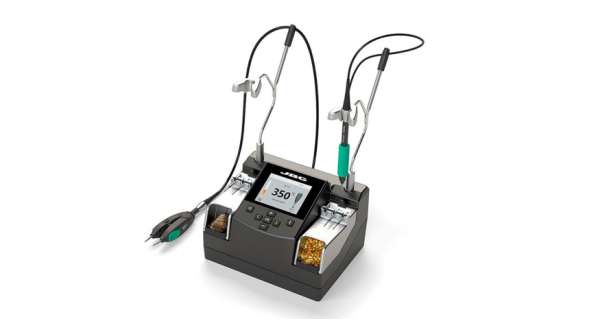
NASE 2 TOOLS NANO REWORK STATION FROM JBC TOOLS

$
0
0

NASE 2 Tools Nano Rework station is one of the best solutions for soldering and rework of SMD componentsrequiring the highest precision. It works simultaneously with the NT115-A Nano Handpiece and the AN115 Steady Nano Tweezers. The short distance from the tip to the handle offers maximum control even when using a microscope.

NASE 2 TOOLS NANO REWORK STATION FROM JBC TOOLS

Temperature Dynamic Profiles

The NASE-C comes with the new Temperature Dynamic Profiles functionality. The use of these profiles allows you to control the temperature of the component during all the phases of the soldering process, emulating the heating process in a reflow oven.

Its easy to use menu is configurable in 10 different languages: English, German, Spanish, French, Italian, Portuguese, Russian, Japanese, Korean and Chinese.

The NASE-C Rework Station works with the C115 Cartridge Range.

Specifications

  • Temperature: 90 to 450 ºC / 190 to 840 ºF
  • Dynamic Soldering Profiles: Designed to avoid thermal shock when soldering Ceramic Chip components like MLCC, this new and unique feature allows controlling the heating ramp up rate of the tool to gradually increase the temperature of the component through all the phases of the soldering process.
  • Up to 25 fully configurable soldering profiles can be stored.

Special Features

  • Sleep and Hibernation mode: These modes lower soldering tip temperature when the tool rests in the stand in order to avoid oxidation and extending tip life.
  • Max. and min. temperature: Limit the temperature range in which the operator is allowed to work.
  • Temperatue levels: Instant selection of up to 3 editable temperature settings for solder joints with different heat requirement.
  • Soldering graphics: Real time visualization of tip temperature and power delivered to the solder joint during soldering process.
  • PIN protection: Keep station parameters protected against unauthorized access.
  • 10 user interface languages: English, German, Spanish, French, Italian, Portuguese, Russian, Japanese, Korean, Chinese.c

Read more: NASE 2 TOOLS NANO REWORK STATION FROM JBC TOOLS

The post NASE 2 TOOLS NANO REWORK STATION FROM JBC TOOLS appeared first on PIC Microcontroller.


SENSETEMP – AN ACCURATE AND FLEXIBLE FOUR-CHANNEL TEMPERATURE SENSOR

$
0
0

SenseTemp by Capable Robot Components is an accurate and flexible four-channel temperature sensor for instrumenting electronics that is compatible with Adafruit M0 Adalogger and is of course Open Source.

SENSETEMP – AN ACCURATE AND FLEXIBLE FOUR-CHANNEL TEMPERATURE SENSOR

SenseTemp is an open source, four-channel temperature sensor designed for instrumenting electronics. It uses extremely accurate platinum resistive temperature detector (RTD) elements which are small enough to place directly on ICs, heatsinks, and other points of interest on an electronic circuit board.

Features & Specifications

  • Small: The resistive temperature detector (RTD) elements are 2 mm x 4 mm x 1 mm, making them thermally responsive and great for measuring small or dynamic point heat sources. The interface PCB is also small and easy to mount to a mobile system or within existing equipment.
  • Battery Powered: including Li-Poly & USB power banks
  • Wireless Option: to make test setup faster and more flexible
  • Accurate: to ensure that temperature data is useful, actionable, and repeatable
  • Sensing
    • Sensor: platinum resistive temperature detector (RTD) driven by MAX31865
    • Channels: 4
    • Accuracy: ±0.32°C @ 0°C and ±0.39°C @ 100°C (see below)
    • Range: -50°C to 260°C (when using silicone harness)
  • Actuation (SenseTemp TEC only)
    • Thermo-electric cooler (TEC) driver: VNH5019A + necessary passives for 12 V Peltier junction (@ 5 A or less)
    • Auxiliary switchable power output (12 V @ 1 A) for driving fan or other device
  • Sensor Cable Harness
    • Connector: single 16-pin IDC header breaks out to 4 x four-wire RTD leads
    • Ribbon cable: 30 AWG, 0.025” pitch, silicone insulation
    • Available cable lengths: 0.4 m, 0.7 m, 1.5 m
  • Adafruit Feather Compatibility
  • Software
    • CircuitPython (for feathers with Atmel SAMD21 M0/M4 processor)
    • MicroPython (for feathers with ESP32 processor)
  • Power
    • USB-powered via Adafruit Feather
    • Independent 5 V to 3.3 V regulators for the host Feather and MAX31865
    • SenseTemp only:
      • Supports optional Li-Poly battery
      • Sensing ICs can be powered down to extend battery life
    • SenseTemp TEC only:
      • 12 V power input on two-pin Molex Micro-Fit 3.0 connector
      • 12 V @ 1 A switchable aux power output (for driving a fan or other device)
      • On-board 12 V to 5 V DC-DC converter for USB-free operation ICs

Read more: SENSETEMP – AN ACCURATE AND FLEXIBLE FOUR-CHANNEL TEMPERATURE SENSOR

The post SENSETEMP – AN ACCURATE AND FLEXIBLE FOUR-CHANNEL TEMPERATURE SENSOR appeared first on PIC Microcontroller.

OSRAM’S SFH 5701 AMBIENT LIGHT SENSOR (ALS)

$
0
0

Osram Opto Semiconductors presents the SFH 5701 A01, a new ambient light sensor (ALS) with integrated circuitry (IC).

OSRAM’S SFH 5701 AMBIENT LIGHT SENSOR (ALS)

The SFH 5701 A01 ambient light sensor is Osram Opto Semiconductors’ latest addition to its portfolio for the automotive sector and the company’s first IC-based component for which a separate power supply pin is not required. The ambient light sensor (ALS) is an active component in which the IC is powered by the signal current and is therefore not reliant on an external power supply. It therefore has only two pins instead of three or more, making it much easier to connect and operate. The special filter encapsulation of the SFH 5701 A01 lets mainly green light through and filters out infrared wavelengths very efficiently. This ensures that the surface-mountable component is ideally adapted to the spectral sensitivity of the human eye, which also is most sensitive to light in the green range of the color spectrum. Overall, the sensor detects light in the spectrum between 450 nm and 700 nm – the visible range for the human eye.

SFH 5701 A01 is an analog component with a linear integrated amplifier which supplies a typical signal of 135 µA at 100 lux. The high dynamic range and high sensitivity at low illuminance of 0.01 lux combine to produce reliable light measurements for a wide range of ambient light conditions. The ALS delivers precise measurements even behind dark glass or plastic covers – a major benefit for passenger cell designs. Its footprint of 1.25 mm x 2.0 mm x 0.8 mm also means it is extremely compact. Integrated thermal compensation makes the component insensitive to fluctuations in temperature.

Read more: OSRAM’S SFH 5701 AMBIENT LIGHT SENSOR (ALS)

The post OSRAM’S SFH 5701 AMBIENT LIGHT SENSOR (ALS) appeared first on PIC Microcontroller.

FLIR ETS320 THERMAL IMAGING SOLUTION FOR ELECTRONICS REPAIR

$
0
0

Thermal Imaging Solution For Electronics Testing

The FLIR ETS320 is the first true electronic test bench camera, designed for Quick temperature checks on PCB boards and electronic devices. The FLIR ETS320 is sensitive enough to detect subtle temperature differences with an accuracy of ±3°c, so you can quickly find hot spots and potential points of failure. The 320 × 240 infrared detector offers more than 76 000 points of temperature measurement, eliminating the guesswork of legacy measurement tools. Designed specifically for bench-top work, the battery-powered FLIR ETS320 connects to your pc for immediate analysis and sharing of thermal data. Product comes with camera, mount, stand, power supply, USB cable, and FLIR tools+ software.

FLIR ETS320 THERMAL IMAGING SOLUTION FOR ELECTRONICS REPAIR

Specifications

  • 320 x 240 IR resolution (76,800 pixels)
  • Object Temperature Range -20°C to 250°C (-4°F to 482°F)
  • Vibrant 3” LCD display
  • 45° field of view
  • ±3% measurement accuracy
  • Records standard radiometric JPEGs
  • FLIR Tools+ software provided
  • ensitive enough to detect temperature differences smaller than 0.06°C, for fast identification of faults and thermal gradients.
  • Measurement accuracy of 2°c aids in attaining quality assurance and factory acceptance of printed circuit boards.
  • Ergonomically designed for lab electronics measurement, the ETS320 is battery powered, Wireless, and hands free.
  • With complete measurement and analysis on the camera, the ETS320 measures small components down to 150 µm per pixel spot size, from a minimum focus distance of 70mm.

Overview Video

More information on FLIR and on Datasheet. Price for FLIR ETS320 thermal camera is $2,499 and is available on amazon.com

FLIR One Pro LT Thermal Camera Smartphone Attachment

An alternative and cheaper solution to thermal imaging is the FLIR ONE PRO LT Thermal Imaging Camera attachment for smartphones.

The all new FLIR One Pro LT  gives you the power to find invisible problems faster than ever. Simply attach the FLIR ONE PRO LT to a supported Android phone/tablet with micro USB connector, and turn it into a powerful thermal imager with 4, 800 (80 x 60) resolution. With class-leading MSX technology that overlays visual image details into the thermal image plus VividIR image processing, the FLIR ONE PRO LT lets you see more details and get visual proof that you solved the problem right the first time. Whether you’re inspecting homes, cars, electrical panels, looking for HVAC problems, finding water damage, or having fun in the outdoors, the new FLIR ONE PRO LT is a tool No serious professional should be without.

Read more: FLIR ETS320 THERMAL IMAGING SOLUTION FOR ELECTRONICS REPAIR

The post FLIR ETS320 THERMAL IMAGING SOLUTION FOR ELECTRONICS REPAIR appeared first on PIC Microcontroller.

AXIOMTEK COM EXPRESS TYPE 7 MODULE IS POWERED BY INTEL XEON

$
0
0

Axiomtek has unveiled the CEM700, its first COM Express Type 7 module with 5th Gen Intel Xeon or Pentium CPUs, 2x 10GBASE-KR, 2x SATA III, a lot of PCIe, extended temperature support, and a new Type 7 carrier board. The CEM700 offers processor options from the 16-core Intel Xeon D-1577 and quad-core Pentium D1519 processors from Intel’s 5th Generation “Broadwell-DE” family, led by the 16-core, 1.3/2.1GHz Xeon D-1577, and quad-core, 1.5/2.1GH Pentium D1519.

AXIOMTEK COM EXPRESS TYPE 7 MODULE IS POWERED BY INTEL XEON

The COM Express Type 7 module features two 10GBASE-KR channels and supports two DDR4-2400 SO-DIMM slots for up to 32GB system memory. It also offers a single GbE controller and an NC-SI (Network Controller Sideband Interface) for remote management. The CEM700 provides powerful server-class performance in a small form factor of 125 x 95 mm, which can be incorporated into compute-intensive and space-constrained applications that make use of high data and network throughputs, like edge computing, microserver, data transmission device, and other networking fields. It has 3.5 Grms vibration resistance and an optional heat pipe cooler and heat spreader are available.

The module has an operating temperature range from -20 to +70°C or optionally -40 to +85°C. I/O option includes 4x USB 3.0, 4x USB 2.0, and 2x serial TX/RX interfaces. Single LPC, SMBus, SPI, and I2C interfaces plus 4-in, 4-out DIO are available. For expansion interfaces, there are single PCIe x16 Gen3 and PCIe x8 Gen3 interfaces, and also 8x PCIe x1 Gen2. Additional features include a watchdog timer, hardware monitoring, and Trusted Platform Module (TPM) 2.0.

Features

  • Intel® Xeon® D-1500 and Pentium® Processor D1500 (Broadwell-DE)
  • 2 DDR4-2400 SO-DIMM for up to 32GB of memory
  • 1 PCIe x16 Gen3, 1 PCIe x8 Gen3, 8 PCIe x1 Gen2
  • 2 SATA-600
  • 4 USB 3.0 and 4 USB 2.0
  • Two 10GBASE-KR
  • TPM 2.0 supported

Axiomtek also introduced the CEB94701, which is provided with the COM Express type 7 baseboard to operate with CEM700 and enable fast turnkey evaluation. This enables users to swiftly emulate the functionality for software development and hardware verification. The 305 x 244mm board is equipped with dual SATA III interfaces, dual 10GBASE-KR SFP+ ports, and a single GbE port.

Read more: AXIOMTEK COM EXPRESS TYPE 7 MODULE IS POWERED BY INTEL XEON

The post AXIOMTEK COM EXPRESS TYPE 7 MODULE IS POWERED BY INTEL XEON appeared first on PIC Microcontroller.

SOLIDRUN HUMMINGBOARD SBC GETS A BOOST OF CAN AND SERIAL PORTS

$
0
0

SolidRun has released a new board to their HummingBoard style family called the HummingBoard CBiSolidRunwho specialize in a wide variety of embedded systems and network solutions which are mostly based around ARM and x86 Architecture SBCs, SOMs and Industrial mini PCs, has launched the HummingBoard CBi – an Industrial SBC – different from the previous HummingBoard Edge SBC which was more of a maker/hacker’s board.

SOLIDRUN HUMMINGBOARD SBC GETS A BOOST OF CAN AND SERIAL PORTS

The new HummingBoard CBi is a robust embedded industrial SBC with CAN bus & RS485 connectors, and it’s tailor-made for industrial applications. It is a spin-off of its earlier HummingBoard Edge SBC and it swaps out the HDMI port with a more industrial-proof MIPI-DSI in a sandwich-style board. It also comes with a generic metal enclosure for housing the new SBC.

Just like it’s predecessor, the HummingBoard CBi SBC runs Linux using the same MicroSOM modules on NXP i.MX6with an option for dual or quad-core 1.2GHz Cortex-A9 Cores. Additional, the device enclosure can support temperature range between -40 to 85°C making it ideal for the industrial environment. Regarding OS, it supports different Linux builds from Debian, Yocto Project, BuildRoot, to OpenWrt stacks, and possibly other similar builds.

As expected the Quad Core version costs higher than the Dual Core version. Prices are, $255 for the quad-core modelwith 2GB RAM and $189 for the dual-core model with 1GB RAM.

Like the Edge, the CBi offers similar features if not the same set of features. It provides 4x USB 2.0 ports, 8GB eMMC,  a microSD slot, a WiFi/Bluetooth module, a mini-PCIe slot with SIM slot, as well as a storage-ready M.2 slot. Other features include LVDS, MIPI-DSI, and MIPI-CSI interfaces, as well as an RTC and a wide power input range 7-36V.

The significant difference with the Edge is the addition of CAN and RS485 ports via terminal connectors, an increase in RAM and a configurable push button and LEDs.

Read more: SOLIDRUN HUMMINGBOARD SBC GETS A BOOST OF CAN AND SERIAL PORTS

The post SOLIDRUN HUMMINGBOARD SBC GETS A BOOST OF CAN AND SERIAL PORTS appeared first on PIC Microcontroller.

Viewing all 365 articles
Browse latest View live


<script src="https://jsc.adskeeper.com/r/s/rssing.com.1596347.js" async> </script>